


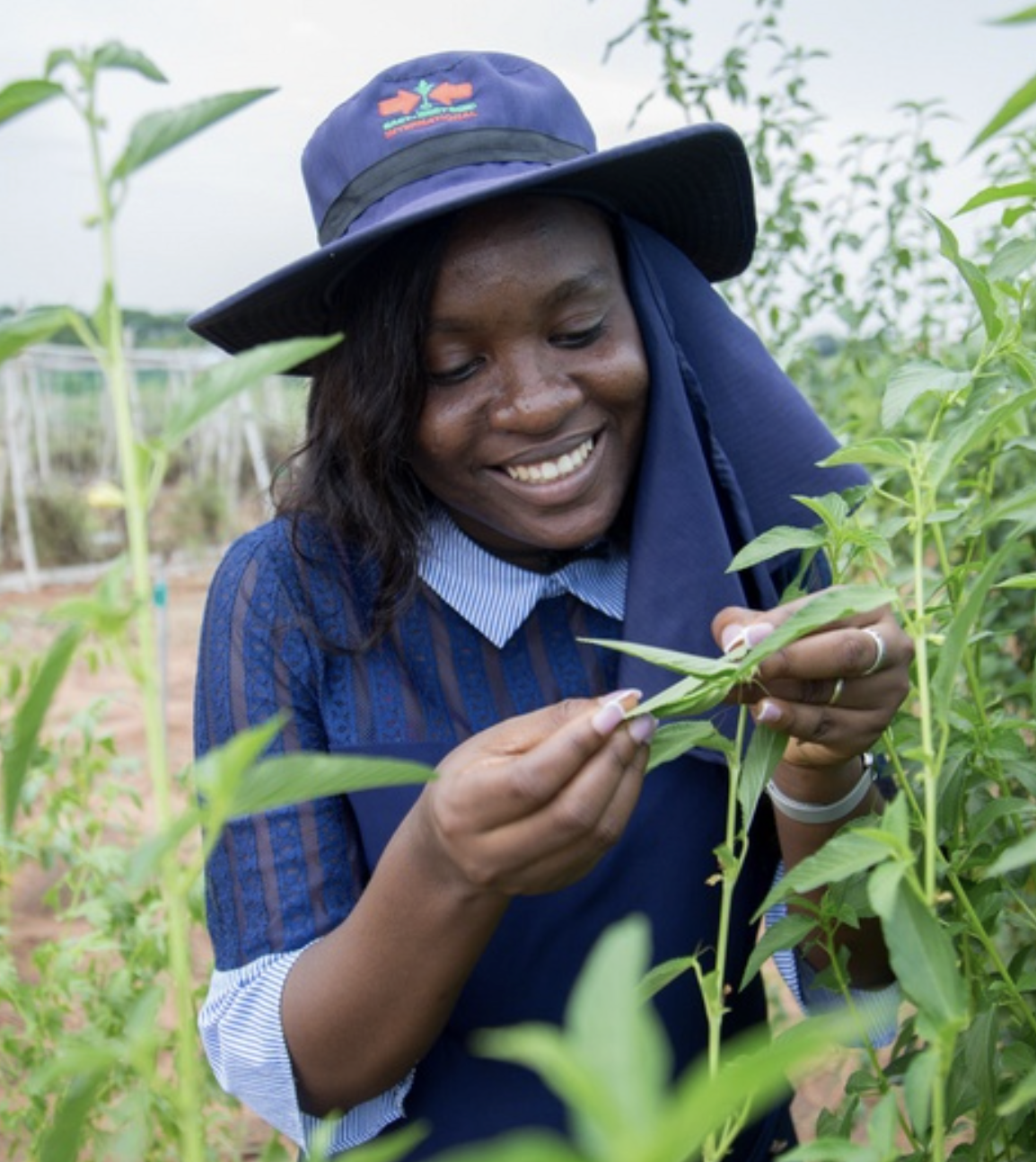
Pamela Afokpe
BENIN
Pamela Afokpe, Plant Breeder and Product Development Specialist at East-West Seed International, has been named the 2026 Recipient of the Norman E. Borlaug Award for Field Research and Application, Endowed by the Rockefeller Foundation. She is recognized for building a highly successful program for the breeding and adoption of improved traditional African vegetable varieties from the ground up. Her extraordinary efforts have led to increased incomes and better nutrition for tens of thousands of smallholder farmers growing these opportunity crops.
Across West Africa, traditional indigenous vegetables such as African eggplant, amaranth and jute mallow have nourished families for generations. Prepared daily in households from Contonou, Benin, to Lagos, Nigeria, and sold by women retailers in open-air markets before dawn, these crops are rich in calcium, iron and other essential micronutrients. Traditional vegetables play a critical role in the diets of some of the region’s most food-insecure communities. Yet for decades, the formal seed sector largely overlooked indigenous African vegetables. With next to no investment in research and development for these crops, farmers faced persistent challenges from low yields, pests, diseases and post-harvest losses.
Afokpe recognized the untapped potential of crops with proven nutritional value, deep cultural significance and established consumer demand. She not only built a research station from scratch to address this need, she pioneered a commercial market across West and Central Africa, leading to the sale of thousands of tons of vegetables that the global seed industry had largely neglected.
In 2017, based at the International Institute of Tropical Agriculture’s campus in Benin, Afokpe was tasked with establishing research and development operations with a limited budget and no local team. Rather than waiting for institutional facilities to be established, she took a proactive approach worthy of Norman Borlaug. She personally cleared a rented field by hand and manually irrigated her first research trial plots. She also traveled across West Africa to obtain genetic materials that could not be found in gene banks, collecting more than 2,000 accessions of indigenous vegetables from farmers and traders. By working directly with growers to understand their production and marketing challenges, she assembled both a valuable genetic collection and a library of local knowledge upon which to build a professional breeding program.
From this foundation, Afokpe developed the Sika variety of African eggplant, the first commercial variety bred for tolerance to bacterial wilt disease and extended shelf life. Initially, Sika faced resistance from farmers and consumers because of its unusual pale green color. Afokpe expertly demonstrated to stakeholders the many benefits of the new variety. Through an extensive outreach campaign, she repositioned a crop often associated with subsistence as a nutrient-dense “superfood” with strong market potential. She showed consumers that Sika’s greater leaf density allowed them to prepare more soup with fewer leaves, increasing its value to households. She conducted shelf-life demonstrations in open-air markets where retailers and farmers could see that Sika’s reduced spoilage meant lower losses and higher profits. She also trained farmers in good agricultural practices, helping them reduce their input costs by 40 percent while improving seedling survival and crop uniformity. For smallholders, typically cultivating less than half an acre, those gains can be transformative.
As a result of Afokpe’s diligent efforts, Sika generated sales of 2,000 tons of produce in its first three years on the market, an unprecedented achievement for an indigenous vegetable variety in the region. The variety has reached up to an estimated 40,000 smallholder farmers.
This breakthrough earned Afokpe the 2025 East-West Seed Platinum Helix Global R&D Award. Her research also precipitated East-West Seed becoming a Vision for Adapted Crops and Soils (VACS) Champion. This global partnership recognizes “opportunity crops,” including traditional African vegetables, as critical to climate resilience and nutrition, a policy shift that Afokpe’s field work has helped validate. She led the effort for East-West Seed to join the African Vegetable Breeding Consortium headed by the World Vegetable Center, and she was selected as a 2024 One Planet Fellow by African Women in Agricultural Research and Development (AWARD) in recognition of her research leadership in helping Africa’s smallholder farmers adapt to a changing climate.
Starting with almost zero infrastructure and limited resources, Afokpe established East-West Seed’s first research and development program for indigenous vegetables in Africa, building a regional research platform that now serves as a hub for breeding, product testing, farmer engagement and training. She manages a growing team of 30 people that has worked tirelessly to introduce more than eight new indigenous vegetable varieties in West and Central Africa. She collaborates closely with farmers, consumers, distributors and research partners across Benin, Burkina Faso, Cameroon, Côte d’Ivoire, Ghana, Mali, Nigeria and Togo to transform traditional vegetables from backyard garden plants into commercial successes.
Afokpe and her mentor, the late Simon Groot (2019 World Food Prize Laureate), shared the vision that high quality seeds, combined with knowledge of good agricultural practices and connection to markets, are the most effective tools for smallholders to improve their livelihoods. Afokpe extended this conviction to vegetables that Groot’s mission had not yet reached, leveraging groundbreaking research and development for oft-overlooked opportunity crops to give growers a resilient, high-yielding future.