


 |
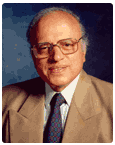
Dr. M.S. Swaminathan
Click here for full bio
The first World Food Prize Laureate, who received the award in 1987, is the highly distinguished international scientist, statesman and humanitarian Dr. M.S. Swaminathan. He has been called a living legend by many and Time magazine ranked Dr. Swaminathan alongside Mahatma Gandhi, the Dalai Lama, and Corazon Aquino as one of the 20 most influential Asians of the Twentieth Century.
Swaminathan's breakthrough discoveries in the early 1960s forever removed the specter of recurring starvation cycles that India had endured for centuries. He cross-bred native Indian wheat plants with Japanese strains and with a dwarf wheat plant developed in Mexico by Dr. Norman E. Borlaug to produce a hardy, high-yielding variety.
“Food security is fundamental to human security,” Dr. Swaminathan said recently, reflecting upon the past 25 years. “Mahatma Gandhi said in 1946 that ‘to the hungry, God is Bread.’ It is in this context that we recall with gratitude the vision of Norman E. Borlaug in getting the World Food Prize established 25 years ago to serve as the equivalent of the Nobel Prize in the field of food and agriculture. The best tribute we can pay to Norman Borlaug is to redouble our efforts to achieve the goal of food for all and forever.”
Dr. Swaminathan credits both his father, who was a politician and medical doctor, and Gandhi, whom he met in his childhood, with inspiring him toward a life of scientific inquiry combined with public service.
Born in India’s Tamil Nadu in 1925, Swaminathan earned a PhD in plant genetics from Cambridge University. In the early 1950s, after a research stint at the University of Wisconsin, he returned home and turned his attention to confronting, and averting, a crisis of food scarcity in India. More than 60 years later, he continues the same efforts that inspired him at the beginning of his career, carrying out research and finding ways to share the results with farmers around the world.
Within two years of the introduction of Swaminathan’s Japanese-Mexican wheat hybrid, Indian wheat production nearly doubled and similar gains in rice production were achieved through the strains developed by scientists working under his direction. By the end of the 1970s, as India was becoming self-sufficient in food production, he began to work on a global scale, first as Director-General of the International Rice Research Institute and later as the founder of the M.S. Swaminathan Research Foundation in Madras (now Chennai).
Dr. Swaminathan has remained active in scientific and policy fields relating to food production, advocating for research and for extension of that research to the farmers. He also passionately advocates for farmland preservation, water conservation and what he calls an “Evergreen Revolution,” which is a holistic sustainable farming system.
In his continuing work on behalf of the poor and hungry of the world, the now 85-year-old Dr. Swaminathan is a realist but also an optimist. “Food and drinking water are the first among the hierarchical needs of a human being," he says. "Growing population, expanding ecological footprint, diminishing per capita land and water availability, increasing biotic and abiotic stresses, high price volatility and above all, the prospects for adverse changes in temperature, precipitation and sea level as a result of climate change emphasize the need for placing agriculture high on the global professional, political and public agenda.
“If you have a coalition of all concerned with the eradication of hunger, I can say it can be done. It can be done. And in my lifetime.”